The Clean Energy Industry Strikes Back: Chip Roy Is Out.
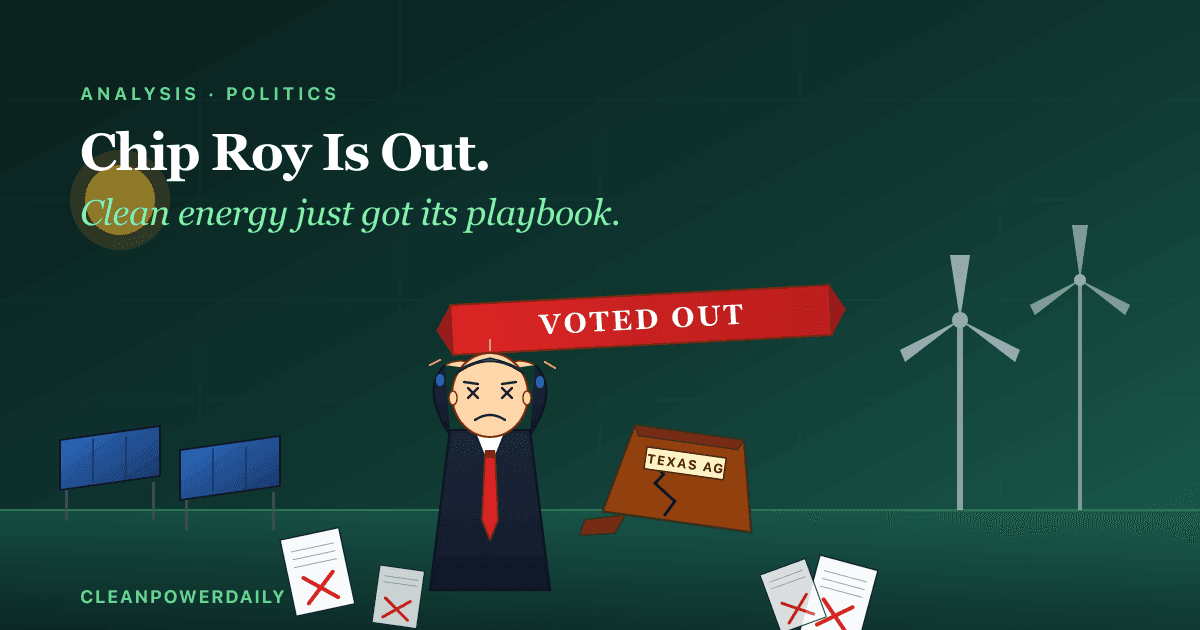
On Tuesday night in Texas, Rep. Chip Roy lost the Republican runoff for state attorney general to Sen. Mayes Middleton by ten points — 55 percent to 45 percent. Middleton will face Democratic state Sen. Nathan Johnson in November for the job Ken Paxton is leaving behind.
This is the win the clean energy industry has been waiting for.
The loudest Republican voice in Washington calling for the full repeal of the Inflation Reduction Act's clean energy tax credits is now headed out of Congress, beaten in part by a solar-backed PAC that spent roughly $1.15 million running ads against him. Roy had spent the past year going further than almost any other House Republican on energy policy — he publicly called for ending "not just the solar and wind credits, but all of them," including carbon capture, storage, and emerging technologies. After the One Big Beautiful Bill Act trimmed those incentives in 2025, Roy was the principal House voice arguing the cuts didn't go far enough. He made the renewables fight personal in a way few other Republicans did.
That's why he was a target. The Invest in Tomorrow Coalition — a PAC formed in early 2026 specifically to oppose him — bet that solar industry money, deployed smartly, could move a Republican primary electorate. It bet on the right race. It picked the right target. And the target lost.
The real question now is whether the rest of the industry will follow Invest in Tomorrow's lead.
What Clean Energy Actually Did
The Invest in Tomorrow Coalition was formed in early 2026 specifically to oppose Roy. Its biggest single donor was Chris Larsen, the cryptocurrency executive and Ripple Labs co-founder who has spent recent years quietly funding clean energy and climate political causes. Larsen put in $250,000. The rest of the PAC's money came from a coalition of solar industry executives and investors.
The PAC spent roughly $650,000 in the primary, where Roy finished second to Middleton's 39.1 percent with 31.6 percent. It then committed at least $500,000 more for the runoff. Total exposure: roughly $1.15 million against a single House Republican.
The tactical move was where this got genuinely interesting. Invest in Tomorrow did not run conventional energy-policy attack ads. Telling Texas Republican primary voters that Chip Roy is bad for solar would have been useless at best and counterproductive at worst. Instead, the PAC ran its ads on MAGA-friendly platforms — Rumble and Truth Social — attacking Roy from the right. The message: Roy had voted to certify the 2020 election, he had publicly clashed with Trump, and he wasn't actually MAGA enough for the job. The ads quoted Trump's past criticism of Roy back at the audience that watched Trump rallies.
This is not the playbook clean energy money has ever run before. The industry's political activity to date has consisted overwhelmingly of donations to Democrats and a small number of moderate Republicans. Spending solar industry dollars on Truth Social to tell MAGA voters that a Republican incumbent is too soft on Trump is a posture the industry has, as far as I can document, never taken in a primary race.
That move alone makes the Roy effort worth analyzing, regardless of the outcome.
The Honest Accounting
Clean energy money didn't beat Roy on its own. It was part of a coalition that did, and being clear about the other pieces is how the industry figures out where to push next.
Middleton self-funded roughly $17 million for his campaign — about fifteen times what Invest in Tomorrow spent. Middleton's message was simple, focused, and consistent: "MAGA Mayes." He branded himself as Trump's man in the race even though Trump never formally endorsed anyone.
Trump didn't have to formally endorse for the signal to land. Roy had voted to certify the 2020 election. He had publicly broken with Trump on multiple occasions over the past five years. By the time of the runoff, the perception that Trump preferred Middleton — even informally — was enough to move the GOP primary electorate. Statewide Republican primaries in 2024 and 2026 have repeatedly shown that even silent Trump preference is close to decisive when one candidate has clearly broken with him publicly and the other hasn't.
Roy had endorsements that should have mattered. His former boss, Sen. Ted Cruz, backed him. So did several House Freedom Caucus colleagues. None of those endorsements moved the runoff electorate.
The most honest reading is this: Roy lost because the Texas Republican primary electorate prioritized Trump loyalty over conservative credentials, and Roy's record on Trump loyalty was weaker than Middleton's. What the clean energy attack ads on Rumble and Truth Social did was give that frame teeth, for an audience that was already receptive. The industry's money put the wedge where the wedge needed to go.
That's how the next race needs to be picked.
What the Industry Just Proved
The tactical move was where this win was earned. For roughly $1.15 million, solar industry money moved on right-coded platforms with right-coded messaging, attacking a Republican from a direction the GOP base actually cares about. That's information the industry didn't have last year, and it's worth more than the $1.15 million it cost to find out.
The replicability question is the right one. Roy was an unusually good target. His 2020 certification vote, his Freedom Caucus clashes with Trump-loyal leadership, his very specific public history of friction with Trump — all of that gave the ads opening material. Most Republicans on the IRA-repeal side don't have Roy's vulnerabilities. Most aren't running statewide against an opponent willing to drop $17 million of his own money.
That's an argument for picking the next target carefully, not for stopping. Invest in Tomorrow found a near-ideal first race and ran a smart play. The same playbook now needs to be tested against Republicans who haven't already broken with Trump publicly, in races where the industry isn't piggybacking on a self-funded MAGA-loyalty challenger. That's where the question of whether this is a one-off or a real shift gets answered.
What This Means for the IRA Repeal Fight
Roy was the loudest, but he wasn't alone. The House Republicans pushing hardest to finish what OBBBA started in 2025 include a small core of Freedom Caucus members and energy-state Republicans who view remaining IRA credits as ongoing subsidies for renewable energy they want eliminated. Roy was the de facto spokesperson for that bloc.
With Roy moving to a state-level race and likely to lose it, the bloc loses its most effective public voice in Congress. That's not nothing. The remaining IRA-repeal coalition will have to find someone else to play that role, and the obvious candidates among Freedom Caucus members don't have Roy's media reach or his ability to set the public agenda on energy.
This doesn't end the IRA repeal effort. Republican leadership has signaled appetite for more cuts to remaining credits, and the 2027 budget cycle is where that fight will play out. But Roy's exit removes one of the few Republicans who consistently kept the issue on the front page.
The bigger question for industry strategists is whether more donors will step in. The Invest in Tomorrow model — small PAC, targeted spending, MAGA-platform ads, attack from the right — is now documented. It's replicable. Running this play in five or six House primaries in 2026 would cost the clean energy industry less than it pays its Washington lobbying shops in a single year.
So far the heavy lifting has been carried by a small group of donors. Chris Larsen's $250,000 was the largest single check the PAC disclosed. The case for more donors to write the next one just got a lot easier to make.
The Read From Here
This is the proof of concept the clean energy industry has been waiting for. It can find the right targets. It can run ads on right-coded platforms that actually move Republican primary electorates. It can do this at a price point that's a small fraction of what the oil and gas industry spends defending its priorities every year.
A reader of the earlier piece on clean energy and hardball politics might fairly ask whether the industry has finally found its footing. The answer is yes — at least in this race, against this target, with this PAC doing the work. The next question is whether the rest of the industry takes the result seriously enough to write the checks needed for the next ten races.
Roy was only the loudest voice for full IRA repeal, not the only one. The replacement bloc is already forming. The industry now has a working playbook, a tested PAC structure, and a Republican incumbent's career as evidence the approach can land punches.
What it needs is more donors willing to write the next check.