Clean Energy Is Finally Learning to Play Hardball Politics
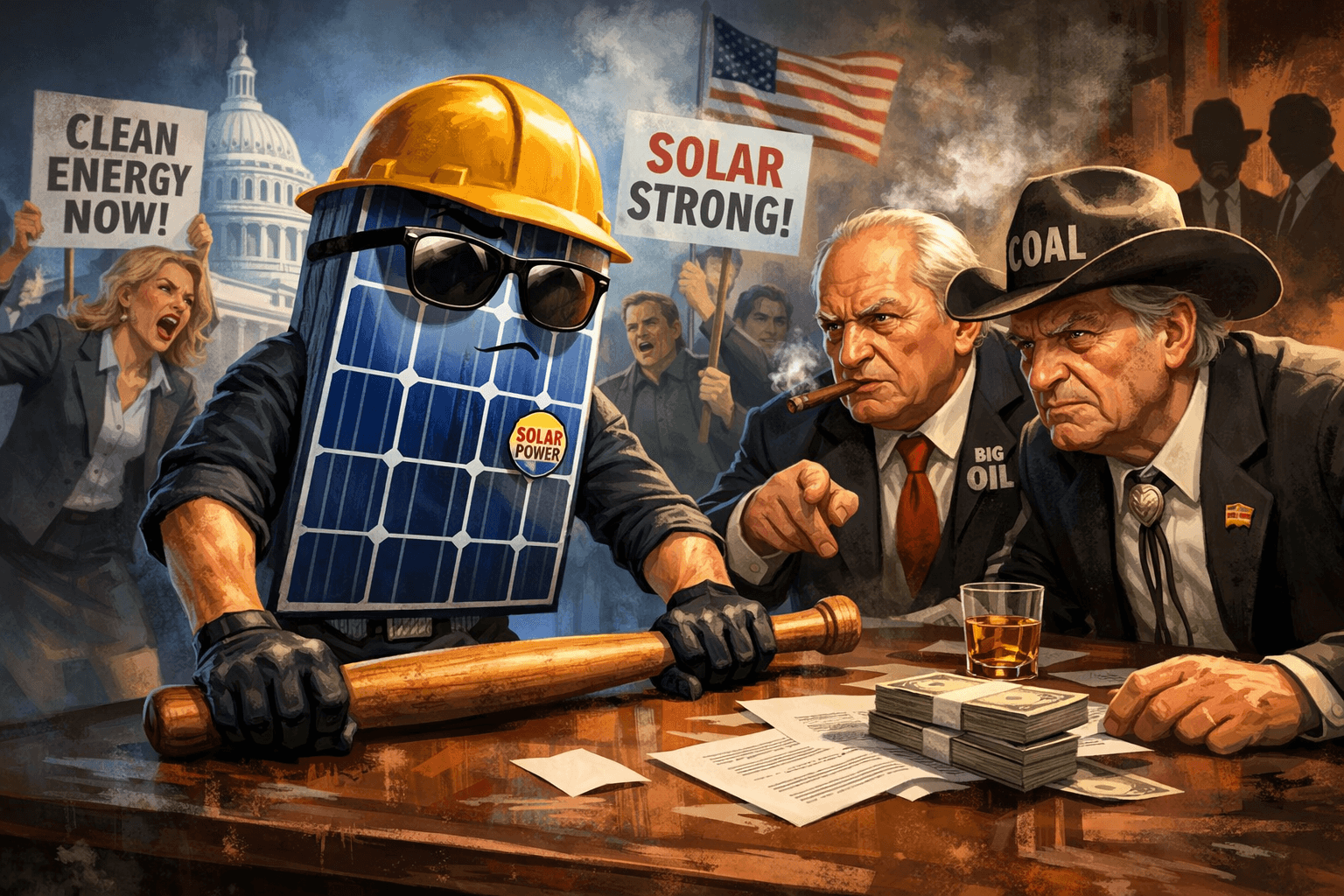
For most of its existence, the clean energy industry hasn't known how to play hardball politics.
It's not for lack of policy wins — it helped craft the Inflation Reduction Act, the most ambitious climate legislation in American history. And not for lack of technology — solar costs have dropped 90% since 2010 and now accounts for over half of all new U.S. generating capacity. What the industry has lacked is the willingness to do what every other established American industry treats as a cost of doing business: the raw, transactional, sometimes ugly work of wielding political power.
That appears to be changing.
In the past few months, the clean energy industry has started doing things that would have been unthinkable even two years ago: running attack ads against Republican members of Congress on Rumble and Truth Social, hiring Kellyanne Conway to poll Trump voters on solar energy, partnering with Stephen Miller's wife for podcast sponsorships, and retaining the same lobbying firms that serve the president's inner circle. The industry that once believed good technology would speak for itself has finally accepted a truth that oil, gas, coal, and every other established American industry learned generations ago — in Washington, you either play the game or you get played.
The Price of Being Above It All
The numbers tell the story of an industry that chose not to fight. From 2008 to 2018, fossil fuel trade associations and allies outspent clean energy groups 27-to-1 on lobbying and political contributions — $2 billion against $74.5 million. During the 2017-2018 election cycle alone, fossil fuel interests spent $359 million in lobbying and campaign contributions while renewable energy companies spent $26 million. That's $13.70 for every $1 from renewables.
It wasn't just a money gap. It was a philosophical one. The clean energy industry was disproportionately staffed by people who entered the field to solve climate change — engineers, scientists, environmentalists who viewed lobbying as distasteful and partisan politics as beneath the mission. The fossil fuel industry had no such qualms. It understood that favorable policy is as important as favorable geology, and spent accordingly.
This mismatch had consequences. While clean energy companies were publishing white papers, oil companies were funding primaries. While solar executives attended policy forums, natural gas lobbyists were on the golf course with committee chairs. The result was an industry that won the economics — solar and wind are now cheaper than fossil fuels in most markets — but kept losing in the rooms where the rules get written.
Then Came the One Big Beautiful Bill
The wake-up call arrived in the form of the One Big Beautiful Bill Act, signed on July 4, 2025. The law gutted most of the Inflation Reduction Act's clean energy tax credits: electric vehicle credits terminated, residential solar incentives killed, and wind and solar projects that don't begin construction by mid-2026 and aren't in service by the end of 2027 locked out of key investment tax credits. Hundreds of billions of dollars in projected clean energy investment evaporated overnight.
It was a legislative massacre, and the industry's traditional lobbying approach — polite meetings, economic impact studies, bipartisan talking points — had failed to prevent it. Rep. Chip Roy of Texas had championed the repeal effort, and the broader Republican conference went along with it despite the fact that red states were the primary beneficiaries of clean energy investment.
The industry had brought a spreadsheet to a street fight. Now, some of its leaders have decided to start throwing punches.
The New Playbook
The most striking example is the Invest in Tomorrow Coalition, a super PAC backed by solar executives including Ripple Labs co-founder Chris Larsen and Aligned Climate Capital CEO Peter Davidson. The PAC spent over $650,000 against Chip Roy in the Texas attorney general primary — not by arguing Roy was bad for the environment, but by running ads on Rumble and Truth Social arguing he "wasn't MAGA enough for Texas."
Read that again. A solar-funded super PAC attacked a Republican congressman from the right. It worked, too — Roy had polled first but finished second, forced into a May runoff. The coalition has announced plans to target other Republican politicians who voted against clean energy interests, including Rep. Barry Moore in the Alabama Senate race.
This is how established industries operate. Oil and gas don't just lobby their friends — they punish their enemies. Pharma doesn't just donate to allies — it primaries politicians who cross them. The clean energy industry has historically done neither, preferring to make the case on merits. The Invest in Tomorrow Coalition represents a fundamental shift: the willingness to make politicians pay a political price.
Meanwhile, the American Clean Power Association — the industry's largest trade group — has launched a campaign called "American Energy First" that reads like it was drafted by a Republican strategist, because it was. According to a strategy memo obtained by POLITICO, ACP engaged Kellyanne Conway's polling firm and conservative influencers to reposition solar power as patriotic and pro-Trump.
According to the memo, the campaign includes paid media partnerships with Katie Miller's podcast (Miller is the wife of White House Deputy Chief of Staff Stephen Miller), though Miller has said she does not have a paid partnership with AEF or ACP. The campaign also includes advertorials in right-leaning outlets like The Federalist, The Dispatch, and the Washington Reporter, and opinion placements from former Republican lawmakers. Conway's polling found that three-quarters of Trump voters in five red states agreed that solar energy should be part of the domestic energy supply, and 62 percent held a favorable view of solar.
The messaging is deliberately stripped of anything that sounds environmental. No mention of climate change, carbon emissions, or sustainability. Instead, it's energy dominance, American manufacturing, China competition, and lower electricity bills. As Mike Carr, executive director of the Solar Energy Manufacturers of America Coalition, put it: the strategy is about "creating a permission structure" for Trump "to not be perceived as getting in the way" of solar — and therefore not be blamed when electricity prices rise.
Learning to Speak the Language
The lobbying approach has shifted too. E&E News reported that energy companies are flocking to firms with direct ties to the Trump White House. Ballard Partners, whose staff includes connections to White House Chief of Staff Susie Wiles, has added energy clients like Constellation Energy and Bloom Energy. Former Interior Secretary David Bernhardt's new firm and Jeff Miller's Miller Strategies are accumulating clean energy clients.
One energy lobbyist told E&E News that working the Trump administration is "something just completely and utterly different than they've ever experienced." Decision-making is centralized in the White House. Companies are told to scrub their social media of any criticism of the president. Loyalty must be signaled before access is granted. It's a pay-to-play environment, and the clean energy industry is finally paying.
This is notable because the renewable energy sector directed 76 percent of its political contributions to Democrats in the 2020 cycle. That's not how you survive in a Republican-controlled Washington. Fossil fuel companies have always played both sides — roughly two-thirds of their donations go to Republicans, but they maintain relationships across the aisle. The clean energy industry is belatedly learning that you don't get to opt out of half the government.
Why Now?
Three forces converged to make this moment different.
First, the existential threat. The One Big Beautiful Bill didn't just trim incentives — it rewrote the investment timeline for an entire industry. Companies with billions in planned projects suddenly faced termination dates. When your business model is on the line, ideological purity about political engagement becomes a luxury.
Second, the political opening. Residential electricity prices were 6 percent higher nationally in December compared to the previous year, with several states seeing double-digit jumps. Republicans hold a four-seat House majority and a six-seat Senate advantage heading into 2026 midterms. GOP strategists are worried that affordability concerns will determine the election outcome. Solar is now the fastest path to new generating capacity — and the fastest answer to the question voters are asking: why is my power bill so high?
Third, the AI data center boom has reshuffled the politics entirely. Trump has made AI infrastructure a centerpiece of his economic vision, but data centers need enormous amounts of electricity — fast. As Mark Menezes, who served as deputy Energy Secretary in Trump's first term, said plainly: "If you need speed to power, the fastest new generation that you can build is solar." When Trump's own data center ambitions depend on the energy source his party just tried to kneecap, there's a crack in the wall — and the industry is finally smart enough to drive a truck through it.
Is It Working?
Early signs suggest yes. Interior Department officials have begun reviewing 20 commercial-scale solar projects, a potential relaxation of Secretary Doug Burgum's requirement that he personally approve all solar and wind permits. The Bureau of Land Management cleared a path for the 700-megawatt Libra Project in Nevada after Republican Gov. Joe Lombardo privately lobbied the administration. Heather Reams, CEO of conservative energy group Citizens for Responsible Energy Solutions, said companies she talks to "are getting their final permits" — a signal she notably did not extend to wind projects.
The ACP's spending tells its own story. The trade group spent a record $3.8 million lobbying federal officials in the second quarter of 2025 — six times what it spent a year prior. SEIA more than doubled its spending to $950,000 in the same period. These are still fractions of what the fossil fuel industry spends, but the trajectory has changed.
None of this means the clean energy industry has caught up to fossil fuels in political sophistication. Oil and gas have been at this for a century. They've built relationships across multiple administrations, funded think tanks that shape the intellectual environment, and created revolving doors between industry and government that keep their interests embedded in policy no matter who's in office. Clean energy is in its first inning of playing this game.
But the fact that solar executives are funding attack ads on Rumble, that the industry's biggest trade group is paying Kellyanne Conway for polling, and that clean energy companies are hiring Trump-connected lobbyists — these are not incremental changes. They represent a fundamental acknowledgment that being right on the merits was never enough. Every mature industry in America knows this. Clean energy is finally growing up.
The question now is whether the industry has the stomach to keep it up. Political engagement isn't a one-cycle experiment. It's a permanent cost of doing business in a democracy. The fossil fuel industry understood this from the beginning. The clean energy industry is learning it the hard way — after losing a fight it should never have lost.